Premium Domain Names Explained: Real Value vs Hype, Buyer Signals, and Red Flags
A premium domain isn’t just “expensive.” It’s a name that can help a business grow by making it easier for people to find you, remember you, and trust you.
That sounds simple, but pricing rarely is. Domains sit at the crossroads of data and human behavior. One buyer sees a short name and thinks “brand.” Another sees the same name and thinks “overpriced.”
This guide keeps it practical for 2026 buyers, startups, creators, and small businesses. You’ll learn what premium really means, which signals buyers trust, what’s mostly hype, and the red flags that can turn a “great deal” into a painful mistake.
What “premium” really means in domain names (and why people disagree)
People disagree about premium domains because “premium” depends on the buyer’s goal. A startup buying its forever brand will value trust and clarity. A domain investor may focus on resale demand. An SEO buyer might care about history and links. Same word, different math.
At the center of it is one question: will this name make it easier to win customers? If yes, the domain can be premium even if it isn’t the shortest or the most obvious.
There’s also a supply issue. The best names are limited. There’s only one exact match for a clean, simple word in a strong extension. Scarcity adds heat to negotiations, and heat often creates hype.
Another reason for disagreement is that the domain market is not like buying a phone. There’s no universal price tag. Two near-identical names can sell for wildly different prices because timing, buyer urgency, and brand fit matter a lot.
Aftermarket premium vs registry premium: same word, very different deal
“Premium” can mean two very different things:
Aftermarket premium is a domain owned by someone (a person, a company, an investor) who set an asking price. This pricing is seller-driven and often negotiable. You can make an offer, use comparable sales, and negotiate terms.
Registry premium is a domain priced higher by the registry (the operator of that extension). These names are sold through registrars like normal registrations, but the price is fixed at checkout most of the time. The biggest trap is that registry premium names can have higher renewal fees, not just a higher first-year cost.
Before you buy any “premium” name, check the renewal price in writing. Don’t assume it renews at standard rates. A name that costs $2,000 today and $2,000 every year after that is a very different purchase than a $2,000 aftermarket buy that renews at $12 per year.
The simple premium test: will this name lower marketing costs or raise trust?
A premium domain usually pays you back in one of two ways: it lowers marketing friction, or it raises trust.
When a domain is easy to say and easy to type, people get to you without extra steps. Fewer mis-typed emails. Fewer “what was your site again?” moments. Fewer clicks lost to confusion.
It can also reduce wasted ad spend. Picture a clean domain on a podcast ad read. If listeners can type it correctly from memory, you’ll see more direct traffic and fewer “close enough” searches that end up on a competitor.
A short example: a company runs ads for “Bright Finance.” If their domain is BrightFinance.com, the ad copy and the landing URL match, and people trust the click. If it’s Bright-Finance-Online.com, some users hesitate, some mistype it, and some Google the name instead. That extra friction costs money over time.
Signals buyers trust when valuing a domain
Good buyers don’t rely on one metric. They stack signals, then decide if the price fits the risk. The strongest signals are surprisingly basic, but they work because they map to real behavior.
Name quality basics: short, clear, and easy to say out loud
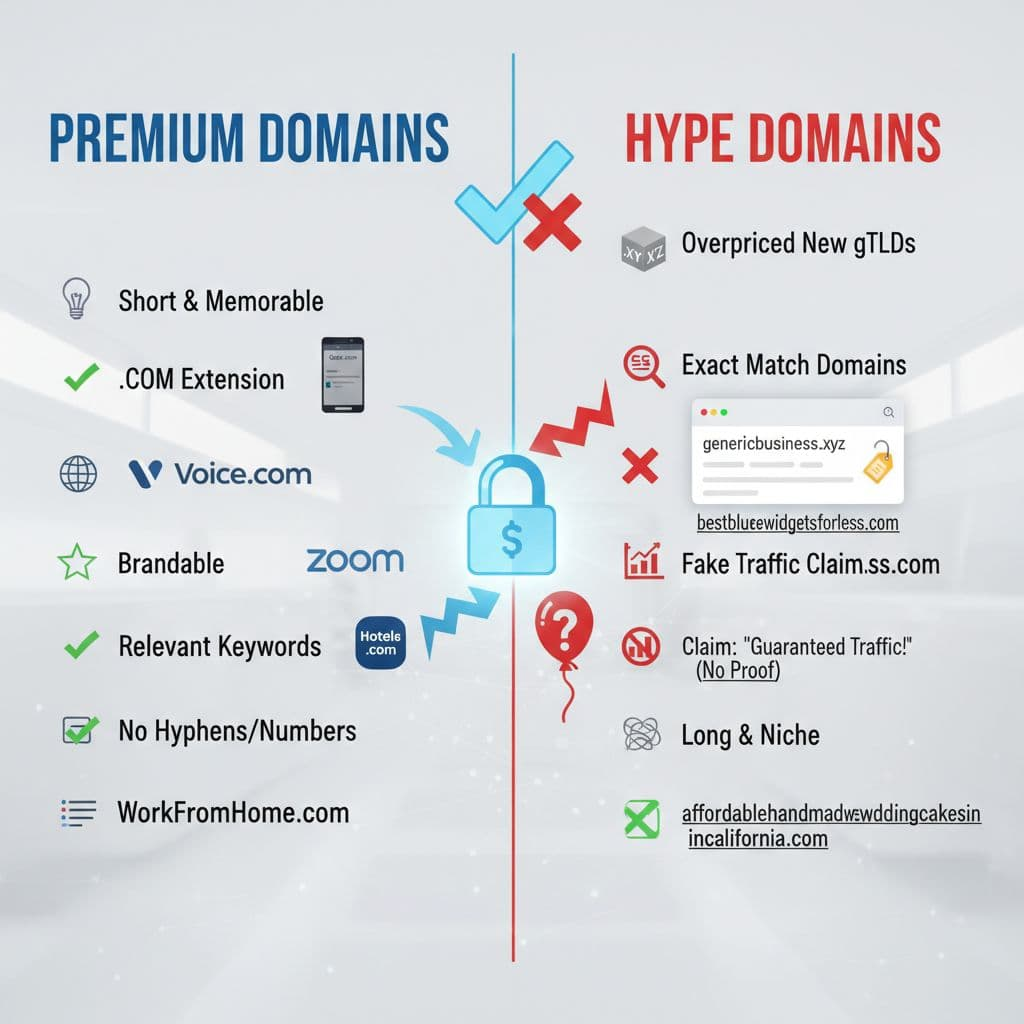
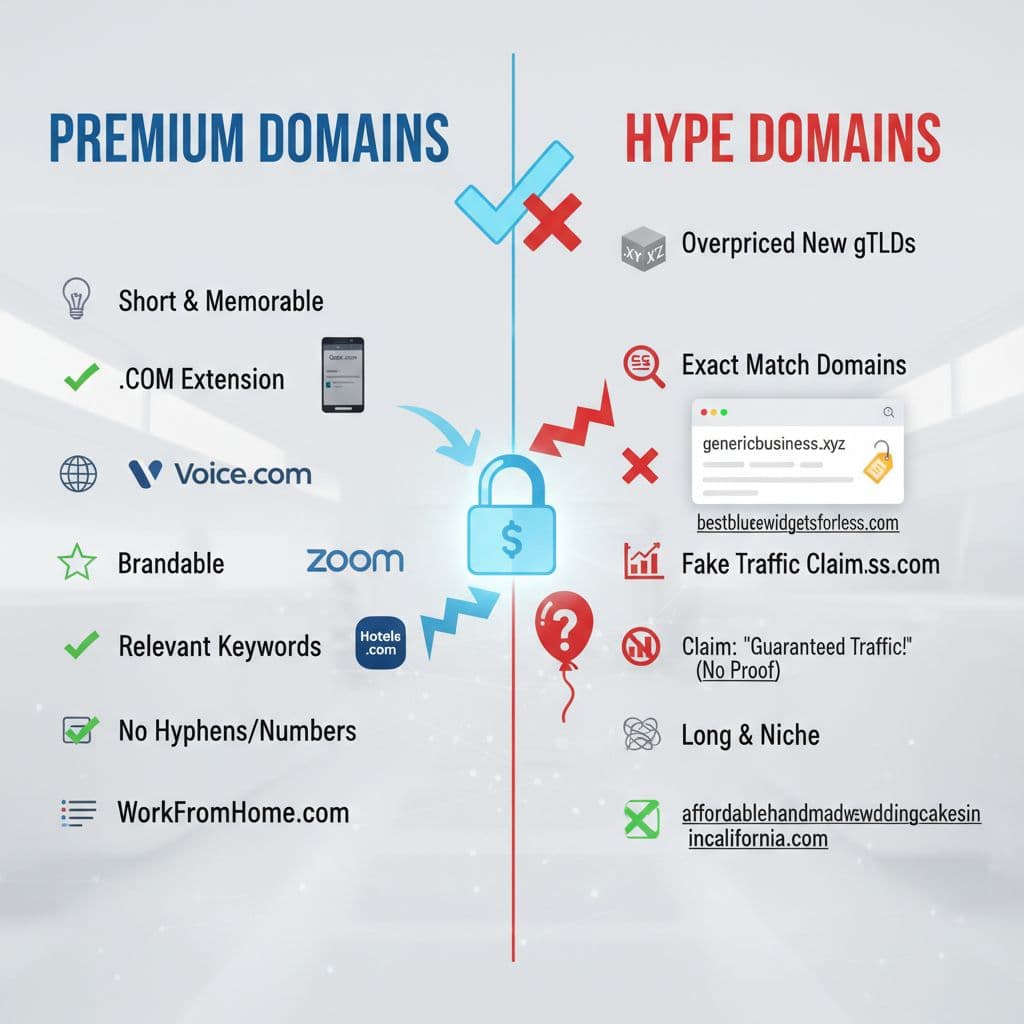
Name quality starts with the “say it once” test. If someone hears the name one time, can they type it correctly without asking follow-up questions?
This is why short, plain names hold value. They reduce the number of ways a person can mess it up. In practice, buyers look for:
- Clean spelling and common words
- Easy pronunciation (no awkward consonant piles)
- Low typo risk (avoid double letters if possible)
- No hyphens and no numbers in most brand use cases
Hyphens and odd spelling can work in rare cases, but they often signal “second choice,” and buyers price that in. Every support ticket that starts with “I can’t find your site” is a tax on your brand.
There’s also the “radio test.” Imagine your domain said on a live show. If you need to add “that’s with a dash” or “that’s spelled with two Z’s,” it’s usually not premium.
Market fit: does it match a real category with buyers and budgets?
A strong domain matches a market where people spend money. That sounds blunt because it is. Buyer budgets tend to follow competition and customer value.
Category names can be valuable when the category is real and crowded. Think terms that describe an industry, service, or product people already search for and already pay for. A broad category can attract many buyers, but it can also be pricey because everyone wants it.
Niche names can still be premium if the niche has high value per customer. For example, a broad domain like “Insurance” has huge demand, but it’s rare and expensive. A niche like “FloodInsurance” has fewer buyers, but those buyers might pay well if the leads are valuable.
Brandable names can win, too. Some categories are so packed with generic terms that a fresh brand is the better move. Buyers still want it short and clean, but they’re paying for identity and memorability, not pure keywords.
A practical way to think about it: broad categories often increase the number of possible buyers, niches reduce buyer count but can increase buyer urgency, if the fit is perfect.
Extension trust: .com still leads, but some alternatives can be strong
In 2026, .com still carries the most default trust. People type it without thinking. It’s also safer for email. If your brand is on a non-.com, you’ll lose some messages to the .com version, even if you do everything right.
That’s why .com domains often command a premium. They reduce confusion, improve click confidence, and cut down on brand leakage.
Other extensions can still be premium when they match how people think:
- Country-code domains can be strong when the business is local and the extension is trusted in that country.
- Some modern extensions work well when the brand is clear and the name reads naturally. If the full domain looks like a real phrase and doesn’t confuse people, it can work.
The warning is resale demand. Many non-.com extensions have thinner buyer pools. If you’re buying for a long-term brand, that might be fine. If you’re buying to resell, the market can be unforgiving.
Comparable sales and demand: what similar names actually sold for
Comparable sales (comps) are the closest thing this market has to “pricing truth.” They don’t give you a perfect answer, but they keep you honest.
The key is to compare apples to apples:
- Same extension (a .com comp is not the same as a .net comp)
- Similar length and style (one-word, two-word, brandable, acronym)
- Similar market type (healthcare vs hobby names often price differently)
- Similar time frame (older sales can be less useful if market mood changed)
Also, asking prices are not sales prices. Marketplaces are full of optimistic listings that never sell. A buyer who quotes only listing prices is guessing. A buyer who quotes closed sales is negotiating.
When you can, look for multiple comps. One sale can be an outlier. Several sales create a range you can trust.
Clean history and ownership proof: fewer surprises, higher confidence
Risk kills deals. A domain with a clean story often sells faster, even if it’s not the absolute best name.
Buyers like to see:
- Clear proof the seller owns the domain and can transfer it
- No obvious spam or malware history tied to the name
- No major reputation mess showing up in search results
- A normal, documented transaction process (escrow, clear timelines)
In many purchases, a clean history matters more than minor SEO metrics. A buyer can build content. A buyer can run ads. A buyer can’t easily erase years of bad use tied to a domain name.
What’s mostly hype (or only matters in certain cases)
Some domain “value” talk is real, but it’s often misused. The trick is knowing when a factor matters and when it’s just a shiny chart.
“High DA” and backlink charts: useful for SEO deals, risky for brands
SEO metrics like Domain Authority style scores get thrown around in sales pitches because they sound scientific. The problem is that these numbers can be inflated, faked, or built on unrelated links.
They matter in a narrow case: when you are buying an aged domain for an SEO project and you can verify the links are real, relevant, and clean.
For brand buys, big backlink numbers can be a distraction. A brand domain should be chosen for clarity and trust, not for a chart. If the links are spammy or off-topic, they can bring baggage. It’s like buying a used car with a “power upgrade” that also has a mystery engine noise.
Exact match keywords: not a guaranteed ranking shortcut anymore
Exact match keyword domains used to feel like a cheat code. Today, search engines care more about content quality, site trust, and user behavior.
Keywords still help, just in a more grounded way. They can:
- Make the purpose of the site clear
- Improve click confidence when users see the URL
- Help with memorability when the phrase is common
But they don’t replace good pages. A domain like BestCreditCards.com still needs strong content, real comparisons, and trust signals to rank. Without that, it’s just a name.
“Aged domain equals premium”: age helps only if the past is clean
Age can be a positive signal because it suggests stability. It can also be a trap. Old domains can carry old problems, including spam use, penalties, or messy ownership history.
A clean two-year-old domain can be safer than a 20-year-old domain that changed hands multiple times and got used for low-quality content. When buyers pay for age alone, they’re sometimes paying for a story they didn’t verify.
Appraisal tools and “estimated value” badges: a starting point, not a price tag
Automated domain appraisals are rough guesses. Different tools often produce different numbers because they weigh factors differently. They also can’t know your buyer’s intent, your negotiation skill, or the timing of your market.
Use appraisals as a sanity check, not a price tag. If a tool says $200 and the seller wants $50,000, you should ask why. Then you still validate with comps, market fit, extension demand, and risk checks.
Red flags to avoid before you pay premium money
A premium price should buy confidence. If anything feels slippery, slow down. The cost of fixing a bad buy can be higher than the purchase price.
Trademark and brand confusion risk: the fastest way to lose a domain
Trademark issues are not just “legal stuff for big companies.” If you buy a domain that matches an existing brand in a related space, you can lose the domain, or spend money defending it, or both.
Avoid domains that:
- Match known brands, products, or slogans
- Are common misspellings of famous companies
- Look like they were bought to ride on someone else’s name
Do basic searches before buying. Check the obvious places, search engines, app stores, and social platforms. For bigger buys, talk to a legal pro. Spending a little on advice can save you from paying for a domain you can’t keep.
Hidden costs and bad terms: premium renewals, leases, and payment traps
The headline price is not the whole price.
Watch for:
- Premium renewals (common with registry premium domains)
- Escrow fees and who pays them
- Transfer fees or surprise “handling” charges
- Lease-to-own contracts with strict late rules
Insist on clear written terms. Who pays escrow. When the domain transfers. What happens if one payment is late in a lease. If the seller won’t put it in writing, don’t pay premium money.
Shady sales behavior: pressure tactics, fake interest, and unverifiable claims
High-pressure selling is a signal that the value can’t stand on its own. Common tactics include “another buyer is waiting,” screenshots with no proof, and vague claims about traffic or offers.
A few behaviors should stop a deal fast:
- Refusing escrow without a strong reason
- Pushing you to pay off-platform in a way you can’t dispute
- Claiming “guaranteed” results or “guaranteed” resale value
- Dodging basic questions about renewal fees or ownership
Take your time. A real premium domain will still be premium tomorrow. Urgency is often manufactured.
Toxic domain history: spam, adult content, malware, or public backlash
A domain can carry reputation like a smell in a room. Even after you build a new site, traces of past use can show up in search results, security tools, or user memory.
Quick checks that buyers often run:
- Look at old snapshots (to see what used to live there)
- Search the domain name in quotes and without quotes
- Check for signs of blacklisting or security warnings
- Scan for patterns like sudden topic changes and thin content
If the domain has a toxic past, cleaning it up can take months. Sometimes it never fully clears. That cost should come off the price, or you should walk away.
Conclusion
A premium domain is the one that helps your business win, not the one that simply has the biggest price tag. The safest way to judge that is a short checklist: name quality, market fit, extension trust, comparable sales, clean history, total cost (including renewals), legal safety, and a safe transaction using escrow.
Before you pay premium pricing, decide your goal first (brand, resale, or an SEO project). Then pick three candidate domains, run the checks, and negotiate with comps in hand. The best deals tend to go to buyers who stay calm and verify everything.